
Confused about what gear to buy? Here are the 7 essential woodworking tools for beginners that won’t break the bank.
I still remember the first “woodworking” tool I ever bought. It was a laser-guided, digital-display miter gauge that cost me about $150.
Note: This post contains affiliate links. If you buy through them, I may earn a commission at no cost to you. I only recommend tools I trust.
I didn’t own a saw yet. But man, I was ready to measure some angles.
That gadget sat in its box for three years. Meanwhile, I was struggling to cut a straight line through a 2×4 with a rusty hand saw I found in my dad’s basement.
This is the trap we all fall into. We watch YouTube videos of guys with $50,000 workshops, massive table saws, and wall-mounted dust collection systems, and we think, “I can’t build anything until I have that.”
Here is the truth: You are wrong.
I work out of a cramped workspace that’s usually occupied by overflow storage and a mountain of kid’s bicycles. I don’t have room for huge machines. And yet, I build furniture, sheds, and gifts all the time.
You don’t need a shop full of robots. You just need a few reliable workhorses. If I had to start over from scratch today with a limited budget, these are the only 7 tools I would buy.
1. The Circular Saw (The Versatile Workhorse)
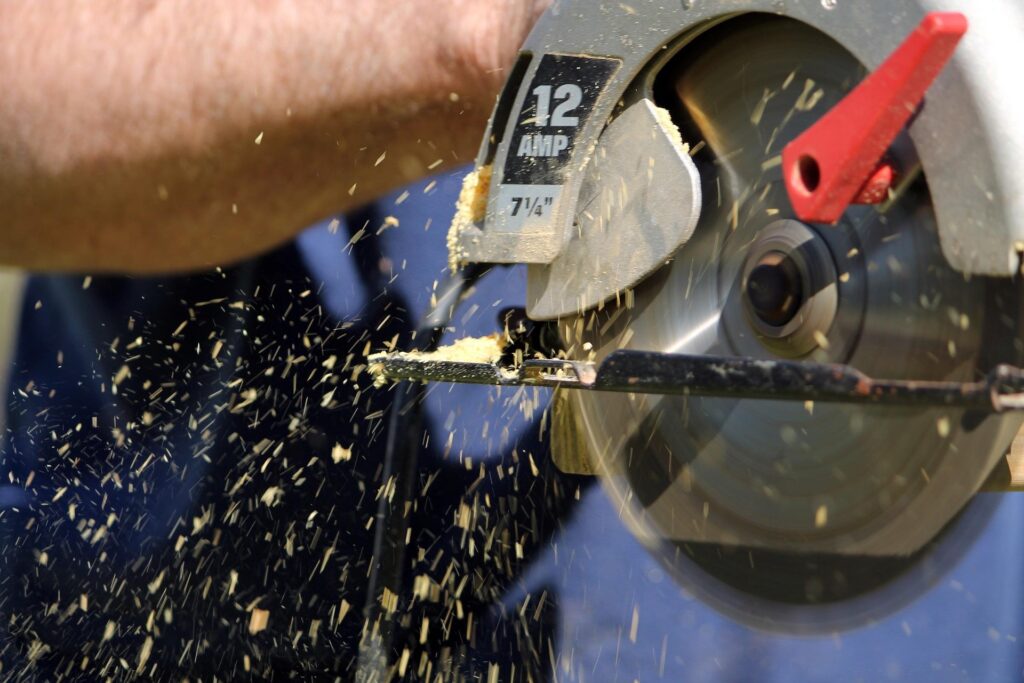
If you ask a pro what the most important tool is, they might say a table saw. But a decent table saw costs $500 and takes up half your garage.
For the beginner, the circular saw is king.
With a simple straight-edge guide (which you can make out of scrap wood), a circular saw can do 90% of what a table saw does. You can break down big sheets of plywood, cut 2x4s to length, and even cut angles. It is portable, powerful, and easy to store on a shelf when you’re done.
Why You Need It: It cuts the wood. That’s the whole job. Without this, you aren’t a woodworker; you’re just a guy with a pile of lumber.
- Budget Pick: Skil 15 Amp Circular Saw with Laser Guide. It’s cheap, it’s light, and the laser helps you stay on the line.
- Pro Pick: Makita 5007Mg Magnesium Circular Saw. This is what I use now. It cuts through oak like butter and will last you twenty years. [INSERT CHECK PRICE BUTTON]
2. Power Drill/Driver Combo
Notice I didn’t just say “Drill.” I said “Combo.”
When you are building, you are constantly doing two things: drilling holes (pilot holes) and driving screws.
If you only have one drill, you will spend half your life switching bits. Drill the hole. Switch bit. Drive the screw. Switch bit. Drill the next hole. It’s maddening.
Buy a kit that comes with a Drill (for making holes) and an Impact Driver (for sinking screws). The Impact Driver is a game-changer. It uses rotational concussion to drive long screws into thick wood without stripping the head. It makes that satisfying ugga-dugga noise and feels like a superpower.
Why You Need It: Because using a manual screwdriver to build a deck will give you carpal tunnel syndrome in an hour.
- Budget Pick: Ryobi One+ 18V Combo Kit. For the weekend warrior, Ryobi is unbeatable value. The battery ecosystem is huge.
- Pro Pick: DeWalt 20V MAX XR Brushless Kit. These are beasts. They run longer, hit harder, and can survive being dropped off a ladder (ask me how I know).
3. Random Orbital Sander
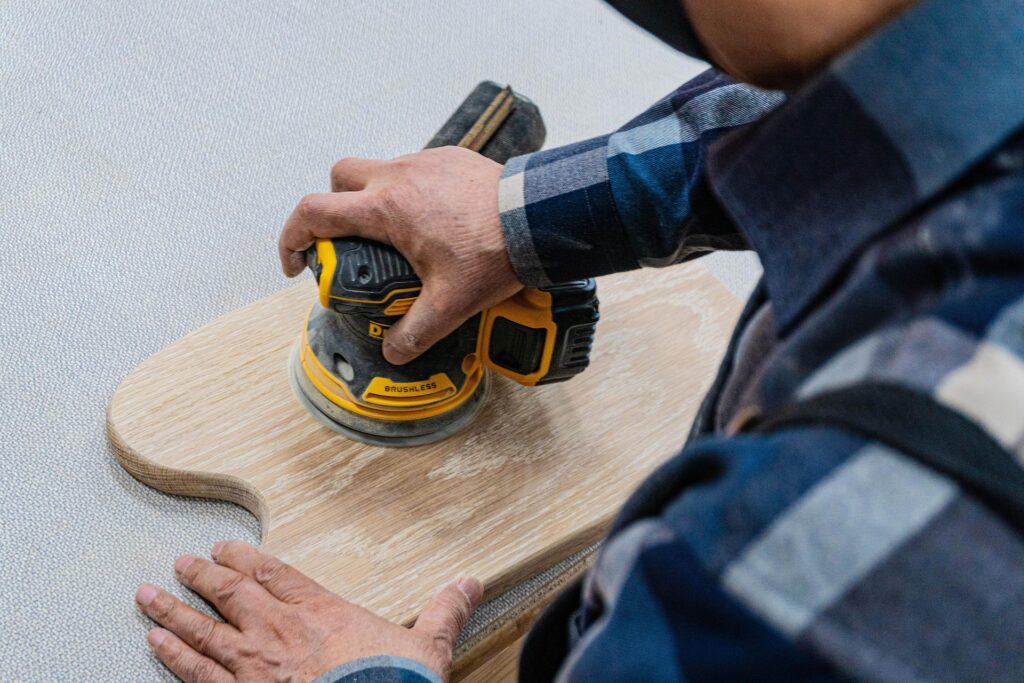
Sanding is the part of woodworking that everyone hates. It’s dusty, it’s boring, and it makes your arm numb.
If you try to sand a tabletop by hand with a block of wood and some paper, you will quit the hobby. I guarantee it.
A Random Orbital Sander spins the sanding disc while also wiggling it in an ellipse. This random movement prevents those ugly “swirl marks” you get from cheaper sanders. It eats through rough wood quickly and leaves a finish that feels like glass.
Why You Need It: Because the difference between “DIY junk” and “Professional Furniture” is usually the finish. Smooth wood takes stain better and looks expensive.
- Budget Pick: Black+Decker BDERO100. It vibrates a lot, but it gets the job done for under $40.
- Pro Pick: Bosch ROS20VSC. The vibration control on this is amazing. Your hand won’t feel like it’s buzzing for an hour after you stop.
4. Jigsaw
The circular saw is for straight lines. The jigsaw is for everything else.
Want to cut a curved back for an Adirondack chair? You need a jigsaw. Want to cut a notch out of a shelf to fit around a pipe? Jigsaw.
It’s not a precision tool like a band saw, but it is incredibly versatile. It’s basically a motorized coping saw. You can change the blades to cut wood, metal, plastic, or even ceramic tile.
Why You Need It: Creativity. Straight lines are boring. Eventually, you’re going to want to cut a curve, a circle, or a weird shape.
- Budget Pick: BLACK+DECKER Jig Saw, 5.0 Amp. Simple, effective, and cheap.
- Pro Pick: Bosch JS470E Top-Handle Jigsaw. This tool doesn’t drift. It cuts exactly where you point it, which is rare for jigsaws.
5. Speed Square
This is the cheapest tool on the list, and I use it on every single project.
A speed square (or rafter square) is a metal triangle. But it’s not just for measuring.
- It’s a Saw Guide: You hold the square against the wood, run your circular saw along the edge, and boom—perfect 90-degree cut. No guessing.
- It’s a Protractor: It has angles marked on it so you can quickly mark 45 degrees, 30 degrees, or whatever you need.
- It’s Indestructible: You can drop it, step on it, or use it to pry open a paint can.
Why You Need It: Eyeballing a cut never works. If your cuts aren’t square, your project won’t fit together. This $10 tool solves that.
- The Only Pick: Swanson Tool Co. Speed Square. Don’t buy the plastic ones. Buy the metal one. It will outlive you.
6. Tape Measure (Why “FatMax” Matters)
“A tape measure is a tape measure, Tony.”
No. It isn’t.
Cheap tape measures are flimsy. You extend them three feet, and they buckle and fall to the floor. This is incredibly annoying when you are trying to measure a span by yourself.
You want a tape with “standout.” This means you can extend the tape 8, 9, or 10 feet into the air, and it stays stiff.
Why You Need It: Accuracy is everything. Also, frustration management. Fighting with a floppy tape measure while standing on a ladder is not fun.
- Budget Pick: Craftsman 25-Foot Tape. Decent, readable, gets the job done.
- Pro Pick: Stanley FatMax 25-Foot. The gold standard. It has 11 feet of standout. It’s bulky, heavy, and totally worth the extra $5.
7. Clamps (The “N+1” Rule)
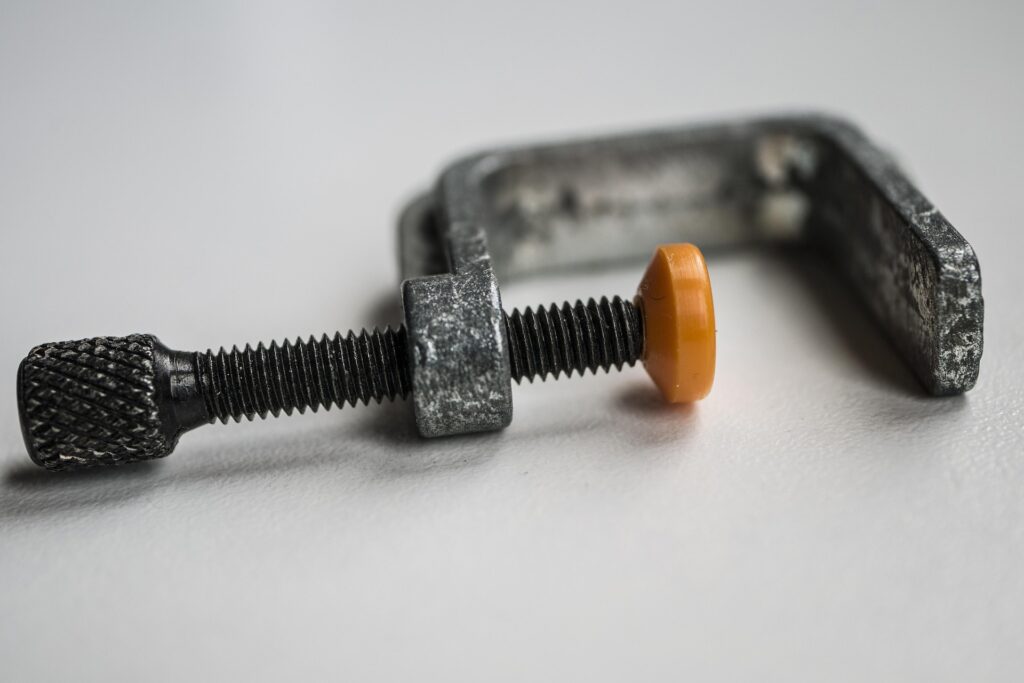
There is an old joke in woodworking: How many clamps do you need? Just one more than you currently own.
It’s true. When you are gluing boards together, you need pressure to make the bond strong. If you don’t clamp it tight, the joint will fail.
You can’t hold it with your hands for two hours while the glue dries. You need clamps.
Start with a few “F-style” bar clamps. They are versatile and easy to adjust.
Why You Need It: glue is slippery. Without clamps, your wood will slide around, and your project will dry crooked.
- Budget Pick: Harbor Freight / Irwin Quick-Grips. Good for light-duty holding.
- Pro Pick: Bessey K Body Revo Parallel Clamps. These are expensive, but they apply massive pressure evenly. Save up for these later.
Conclusion: Skills > Gear
You can buy all the tools on this list for less than the price of one high-end table saw. And honestly? That’s all you need to get started.
Don’t let the gear snobs scare you. Some of the most beautiful furniture in history was built by guys using hand saws and wooden mallets.
The tool doesn’t make the craftsman; the practice does.
So, grab a circular saw, buy some cheap pine, and build a box. It might be crooked. It might be ugly. But you built it.
What was the first tool you bought? Did you actually use it, or did it gather dust like my laser guide? Let me know in the comments!